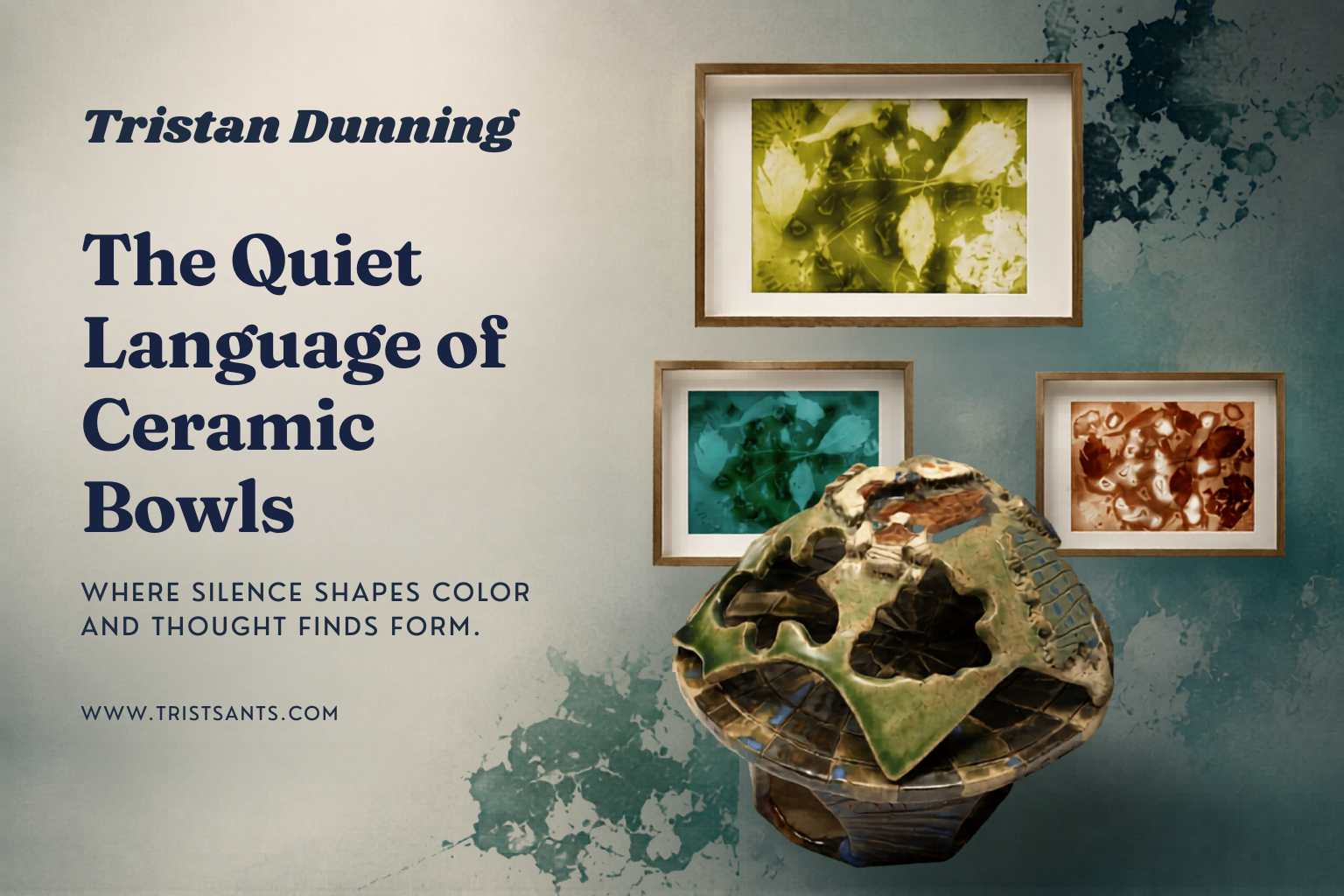
The Quiet Language of Ceramic Bowls Where Silence Shapes Color and Thought Finds Form
Some artworks do not ask to be understood immediately. They sit in silence, carrying something deeper beneath their surface. These ceramic bowls belong to that category. At first glance, they are visually striking objects shaped with care and finished with rich tones of blue and purple. Yet the real story begins when you spend time with them.
The bowls are not just vessels. They are reflections of an internal landscape shaped by dyslexia, where thoughts do not always follow a straight line and expression often requires negotiation with language itself.
What makes these pieces stand apart is not just their aesthetic presence but the lived experience embedded within them.
Explore the Story Within the Form!
Color as a Cognitive Map
The most noticeable feature across the bowls is the interplay of blue and purple hues. These colors do not sit in isolation. They blend, overlap, and sometimes appear to interrupt one another. This is not accidental.
Blue often conveys a sense of calm, depth, and stillness, while purple carries a more complex tone, often associated with introspection and emotional depth. When these colors merge across the curved surfaces, they create a visual rhythm that feels fluid yet slightly unsettled. That tension mirrors the way information is processed differently by someone with dyslexia.
The gradients do not follow a rigid pattern. Instead, they move organically across each piece, suggesting a thought process that adapts, shifts, and reconfigures itself. Each bowl becomes a map of cognition rather than just a decorative object.
Form That Holds Struggle and Adaptation
The bowl shape itself is familiar, almost universal. It is something used, held, and understood without effort. But here, that familiarity becomes a quiet contrast to the internal complexity it represents.
Each piece carries subtle variations. No two forms are exactly alike. Some edges feel slightly uneven. Some curves appear more pronounced. These differences matter. They echo the idea that learning and processing are not uniform experiences.
Dyslexia introduces roadblocks in areas that many take for granted. Reading, writing, structuring a sentence, and even organizing thoughts can take significantly more time and effort. That delay is not visible from the outside, yet it shapes the entire experience of learning.
These bowls translate that invisible effort into physical form. They hold the idea that progress is not about perfection but about finding alternative paths. The slight irregularities become markers of persistence rather than flaws.
The Unspoken Weight of Language
One of the most striking aspects of this work is the relationship with language itself. Writing a sentence can become an act filled with doubt. Questions arise constantly. Does it make sense? Is the structure correct? Is the meaning clear?
That ongoing uncertainty creates a kind of mental noise. It slows down expression and often turns something simple into something exhausting. The bowls step in where words struggle.
They offer a space where communication does not rely on grammar or syntax. Instead, texture, color, and form take over. The glossy surfaces catch light in different ways, shifting depending on how they are viewed. This changing appearance reflects the instability often felt when trying to express something in writing.
The Unique Strength of This Work
The most defining strength of these ceramic pieces lies in their ability to translate a cognitive experience into something tangible. This is not about illustrating dyslexia in a literal sense. It is about capturing its rhythm, its interruptions, and its workarounds.
The uniqueness does not come from technique alone, although the glazing and finishing are executed with precision. It comes from intent. Each bowl carries a narrative that cannot be reduced to decoration.
They are objects that invite reflection rather than admiration alone. The viewer is not just observing a finished piece but encountering a process of adaptation. That is where their value lies.
Art as a Space Without Barriers
Animation and visual creation often provide a sense of escape for individuals dealing with dyslexia. In this case, that same sense of release is present in the ceramic work. Within these bowls, there is no pressure to structure thoughts into sentences. There is no need to check punctuation or rework phrasing. The act of making becomes direct and uninterrupted.
That freedom is visible in the final pieces. The colors move without restriction. The forms exist without needing justification. The work becomes a space where the mind can operate without the constraints that language often imposes.
Closing Reflection
These ceramic bowls hold more than glaze and clay. They hold time, effort, frustration, and discovery. They represent a way of thinking that does not always align with conventional systems yet finds its own clarity through creation.
To engage with them is to step into a perspective where difference is not hidden but expressed. The beauty of the work lies not in perfection but in honesty.
Explore the Story Within the Form!
If you are drawn to art that carries meaning beyond the surface, these pieces invite you closer. Each bowl offers a quiet conversation, shaped by experience and refined through resilience. Explore a collection where every curve, every color, and every finish reflects a journey that refuses to be simplifie.
